100 Days of Code Day 28
Today’s exercise was line up which was largely simple string substitution with a few edge cases. This one was specified nicely but they really should tell you the type and order of parameters to the function. I shouldn’t have to go look in the test cases to see what they want.
Even more constants changed since my Gameboy programming book was written.
| Book | Current |
|---|---|
| LCDCF_OBJOFF | LCDC_OBJ_OFF |
| LCDCF_OBJON | LCDC_OBJ_ON |
| LCDCF_OBJ8 | LCDC_OBJ_8 |
| LCDCF_OBJ16 | LCDC_OBJ_16 |
| LCDF_OBJ8 | LCDC_OBJ_8 |
| LCDF_OBJ16 | LCDC_OBJ_16 |
| _OAMRAM | Not found |
| OAMF_PAL0 | OAM_PAL0 |
| sizeof_OAM_ATTRS | OBJ_SIZE |
| OAMF_XFLIP | OAM_XFLIP |
| OAMF_YFLIP | OAM_YFLIP |
| _RAM | Not found |
I finished up Chapter 7. I could have moved on to Chapter 8 joypad input, but I didn’t.
Yesterday I made a hello world app. I still had one more simple app I wanted to try and that was the DVD screen saver.
I downloaded LibreSprite so that I could make the tiles more easily and still had problems. There is a pre-built GameBoy palette, but it wanted to save a transparency color if you didn’t fill the entire thing with color (I thought I had but I guess not). Then the graphics conversion threw up because I didn’t have a proper blank tile in the tile map tile space. Eventually I got it working, but it was a pain. Yesterday I downloaded Tiled to make the Hello World map. Today I just wanted a blank background so it wasn’t used.
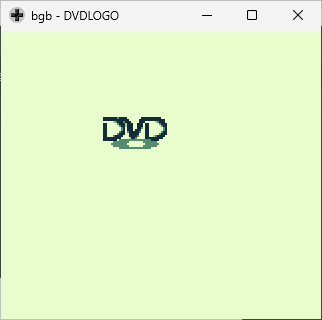
It is just a DVD logo that bounces around the screen. Unfortunately, the GameBoy has a squarish screen so it doesn’t bounce very well, just follows a set path. It still works, and boy did it take a lot more effort than expected to make it work. The logo itself is four 8×16 sprites. I calculated all of the addresses and values in a loop and even used some memory addresses as sort-of variables.
It was a huge amount of assembly (~130 lines) to get it working. Strangely the bouncing seemed to work just fine but setting the status of all of the sprites was a nightmare.
Ok, on to Chapter 8 tomorrow. First, however, the screensaver.